Nuffnang Upper

  • Welcome Message

Recipes Foods

Posted by ho5391 On 8:41 AM 0 comments

These are all the recipes on this site in alphabetical order. I must thank one of my readers, Angeline, who took time to write to me and giving me this suggestion. Since it is a good suggestion, I have worked on it (it’s tedious by the way!) and hope this page will serve as an easy reference for the recipes here. Non-recipe posts such as Food Reviews and Miscellaneous musings are not included here for obvious reasons.

  • Abalone Appetiser with Chilli and Garlic
  • A B C D Soup
  • Asam Ikan Kembung
  • Ayam Sioh (Chicken in Spicy Tamarind Sauce)
  • Baked Beans with Minced Pork and Potatoes
  • Bak Chang
  • Bak Kut Teh
  • Bee Hoon with Chicken Frankfurters and Chinese Mushrooms
  • Belacan Asparagus
  • Belacan Miding
  • Black Bean Soup
  • Black Soy Bean Milk
  • Bovril Chicken
  • Braised Noodles with Stewed Pork Slices
  • Braised Seafood Yee Mein
  • Butterflied Prawns in Eden
  • Cabbage Rice with Lap Cheong
  • Carrot Cake with Lemon Cream Cheese Frosting
  • Char Siew Fried Rice
  • Cheese Biscuits
  • Chicken Chop
  • Chicken Rice cooked using Rice Cooker
  • Chicken with Potatoes, Carrots and Mushrooms
  • Chilli Garlic Tofu Snack
  • Chilli Pork
  • Chinese Leek Flower with Beancurd, Carrots and Prawns
  • Chinese Roast Pork
  • Chinese Stewed Duck
  • Chinese White Radish Soup
  • Choy Sum with Oyster Sauce
  • Choy Sum with Sweet Tau Kee
  • Claypot Chicken with Bitter Gourd
  • Colourful Pork Omellette
  • Corn Soup
  • Curry Chicken with Potatoes
  • Deep Fried Tofu Meat Patties
  • Double Boiled Sweet Herbal Chicken Soup
  • Dragon Fruit Jelly
  • Economy Fried Noodles
  • Egg Flower Minced Pork Soup
  • Egg Fried Rice
  • Eight Treasures Dessert
  • Fish Ball Bee Hoon Soup
  • Fish Ball Tang Hoon Soup
  • Fish Ball Vegetable Soup
  • Four-Angled Beans with Dried Prawns and Chilli
  • Fried Bee Hoon with Stewed Pork Ribs
  • Fried Bitter Gourd with Salted Egg
  • Fried Black Pomfret with Chilli Sambal Paste
  • Fried Fish with Stir Fried Leek Sauce
  • Fried Oyster Omelette – Oh Chien
  • Fried Tomato with Minced Pork
  • Fried Yam and Nian Gao Sandwich
  • Garlic Hoi Sin Chicken
  • General Tso’s Fillet of Tenggiri
  • General Tso’s Pork Chop
  • General Tso’s Pork Ribs in Crock Pot
  • Ginger Sauced Chicken
  • Ginkgo Barley Dessert with Foo Chuk
  • Golden Tapioca Parcels (Kuih Ubi Kayu)
  • Hairy Gourd Soup
  • Homemade Tofu with Mini Treasures
  • Honey Dew and Sago Dessert
  • Hot and Sour Szechuan Vegetable Soup
  • Ikan Bilis Snack
  • Japanese Tofu with Braised Mushrooms and Wood Ear Fungus
  • Kailan cooked in 2 ways
  • Kailan with Shredded Scallops
  • Kangkong Belacan
  • Kiam Chye Tofu Soup
  • Kidney Ginger Soup
  • Kolok Mee
  • Kong Bak with Ho Hup Pau
  • Kuih Lapis
  • Kung Po Chicken
  • Lamb Shoulder BBQ Sauce
  • Lap Cheong Omelette
  • Leek with Fragrant Tofu
  • Lek Tau Suan
  • Linguine with Pan Fried Chicken Breast and Siew Pak Choy
  • Loh Mee
  • Long Bean Rice
  • Long Beans and Peanuts Medley
  • Lotus Soup with Red Dates and Peanuts
  • Luncheon Meat Fried Rice
  • Mee Goreng (Fried Noodles)
  • Mee Hoon Kueh (Flour Cake Soup)
  • Mee Hoon Kueh
  • Mee Siam
  • Mee Suah Soup
  • Minced Pork Balls with Preserved Black Beans
  • Miso Sweet Potato Shoots
  • Miso Tofu Soup
  • Mixed Vegetables – Cabbages, Carrots, Wood Ear Fungus, Dried Lily Buds and Mushrooms
  • Mui Choy Bak (Mui Choy with Pork Belly)
  • Napa Cabbage Rolls
  • Ngor Hiang
  • Old Cucumber Soup (Lao Wang Kwa)
  • One Dish Meal
  • Oriental Broccoli Salad
  • Otak-Otak
  • Oven-Grilled Chicken Wings
  • Pineapple Prawn Sambal
  • Pineapple Jam for Pineapple Tarts
  • Pineapple Tart Pastry
  • Plum Sauce Pork Loin Chops
  • Pork and Dried Oyster Porridge
  • Pork Chop Noodles
  • Pork Leg Hoi Sin Stew
  • Pork Omellette
  • Pork Ribs in Plum Sauce
  • Pork Strips with Capsicum in Hoisin Sauce
  • Popiah
  • Prawn Fried Rice
  • Prawn Siew Pak Choy
  • Pumpkin Rice
  • Pumpkin and Luncheon Meat Combo
  • Q-Chai Soup
  • Red Bean Soup with Mandarin Orange Peel
  • Roasted Boneless Lamb Shoulder Roll
  • Roasted Spicy Brinjals
  • Roti Canai
  • Sambal Ikan Bilis with Tang Hoon
  • Sambal Belacan Baby Corn
  • Sambal Belacan Ladies Finger
  • Sambal Tamarind Hard-Boiled Eggs
  • Sarawak Laksa
  • Sauteed Chicken Supreme with Dried Chillies
  • Scallop Congee
  • Seafood Tom Yam
  • Seaweed Delight
  • Seaweed Soup with Minced Pork
  • Shortbread
  • Shredded Chicken Porridge
  • Siew Pak Choy with Braised Mushrooms
  • Sitiawan Noodle ala PabloPabla
  • Sour and Spicy Ikan Bilis
  • Soft Pork Cubes with Soy Sauce and Potatoes
  • Spicy Beef
  • Spinach Soup with Wolfberries
  • Steamed Chicken with Carrots, Wood Ear Fungus, Dried Lilybuds and Mushrooms
  • Steamed Egg Custard
  • Steamed Japanese Tofu with Minced Pork
  • Steamed Ladies Fingers with Superior Sauce
  • Steamed Minced Pork with Tung Chye
  • Steamed Pork Ribs with Tau Cheo Sauce
  • Steamed Tilapia with Tau Cheo Sauce
  • Stewed Chicken in Dark Soya Sauce
  • Stewed Pork Belly in Dark Soya Sauce
  • Stingray with Taucheo Chilli and Salted Vegetables
  • Stir Fried Asparagus with Prawns
  • Stir Fried Beef with Ginger and Spring Onions
  • Stir Fried Celery with Prawns and Straw Mushrooms
  • Stir Fried Crabs
  • Stir Fried Crunchy Four Angled Beans with Fish Sauce
  • Stir Fried Dwarf Bok Choy with Garlic and Dried Prawns
  • Sir Fried Fish Slices with Ginger and Spring Onions
  • Stir Fried French Beans with Egg
  • Stir Fried Hong Kong Kai Lan with Prawns
  • Stir Fried Instant Noodles
  • Stir Fried Kai Lan Stems with Pork and Mushrooms
  • Stir Fried Kangkong with Garlic
  • Stir Fried Ladies Fingers with Anchovies
  • Stir Fried Ladies Fingers with Dried Prawns
  • Stir Fried Lala Clams Home-Cooked Style
  • Stir Fried Lala Clams with Lemongrass and Bird’s Eye Chilli
  • Stir Fried Leek with Roast Pork
  • Stir Fried Lily Buds with Prawns
  • Stir Fried Long Bean Medley
  • Stir-Fried Mixed Vegetables
  • Stir Fried Mixed Vegetables – Sugar Snap Peas, Baby Corn, Carrots and Mushrooms
  • Stir Fried Mussels in XO sauce
  • Stir Fried Pea Sprouts with Garlic
  • Stir Fried Pork Liver and Kidney with Ginger
  • Stir Fried Pork Tenderloin with Enoki Mushrooms
  • Stir-Fried Soya Bean Sprouts with Ikan Bilis
  • Stir-Fried Pork Tenderloin with Yam
  • Stir Fried Pork with Ginger and Spring Onions
  • Stir Fried Pork with Preserved Szechuan Vegetables
  • Stir Fried Sweet Potato Shoots with Fermented Beancurd
  • Stir Fried Ridge Gourd with Eggs and Prawns
  • Stir Fried Spinach with Wolfberries
  • Stir Fried Sotong with Sarawak Laksa Paste
  • Stir Fried Tender Beef with Capsicum
  • Stir Fried Turnip with Carrot and Dried Prawns
  • Stir Fried Yau Mak with Garlic
  • Stuffed Mushrooms
  • Sugar Snap Peas with Tiny Anchovies
  • Super Fast Noodles
  • Sugared Ghee Balls
  • Sweet and Sour Pork Ribs
  • Sweet and Sour Prawns
  • Sweet and Spicy Brinjal
  • Sweet Potato Porridge
  • Tangy Ladies Fingers
  • Tang Yuen
  • Tasty Fried Baby Back Ribs
  • Tau Yu Bak (Stewed Pork in Soya Sauce)
  • Tea Braised Chicken
  • Teochew Dumplings
  • Tofu with Dried Prawns
  • Tofu with Edamame
  • Tofu with Minced Pork
  • Tofu with Minced Pork 2
  • Vegetarian Mixed Vegetables with Wheat Gluten
  • Watercress and Red Dates Soup
  • Wheat Gluten
  • White Cabbage Fish Balls Soup
  • Worcestershire Fried Belly Pork Snack
  • Wo Tieh (Shallow Fried Dumplings)
  • Yam and Sago Delight
  • Yam Rice
  • Introduction
    Programmable controllers are generally programmed in ladder diagram (or "relay diagram") which is nothing but a symbolic representation of electric circuits. Symbols were selected that actually looked similar to schematic symbols of electric devices, and this has made it much easier for electricians to switch to programming PLC controllers. Electrician who has never seen a PLC can understand a ladder diagram.

    Ladder diagram

    There are several languages designed for user communication with a PLC, among which ladder diagram is the most popular. Ladder diagram consists of one vertical line found on the left hand side, and lines which branch off to the right. Line on the left is called a "bus bar", and lines that branch off to the right are instruction lines. Conditions which lead to instructions positioned at the right edge of a diagram are stored along instruction lines. Logical combination of these conditions determines when and in what way instruction on the right will execute. Basic elements of a relay diagram can be seen in the following picture.
    PLC

    Most instructions require at least one operand, and often more than one. Operand can be some memory location, one memory location bit, or some numeric value -number.In a case when we wish to proclaim a constant as an operand, designation # is used beneath the numeric writing (for a compiler to know it is a constant and not an address.)

    Based on the picture above, one should note that a ladder diagram consists of two basic parts: left section also called conditional, and a right section which has instructions. When a condition is fulfilled, instruction is executed, and that's all!
    PLC

    Picture above represents a example of a ladder diagram where relay is activated in PLC controller when signal appears at input line 0. Vertical line pairs are called conditions. Each condition in a ladder diagram has a value ON or OFF, depending on a bit status assigned to it. In this case, this bit is also physically present as an input line (screw terminal) to a PLC controller. If a key is attached to a corresponding screw terminal, you can change bit status from a logic one status to a logic zero status, and vice versa. Status of logic one is usually designated as "ON", and status of logic zero as "OFF".

    Right section of a ladder diagram is an instruction which is executed if left condition is fulfilled. There are several types of instructions that could easily be divided into simple and complex. Example of a simple instruction is activation of some bit in memory location. In the example above, this bit has physical connotation because it is connected with a relay inside a PLC controller. When a CPU activates one of the leading four bits 10, relay contacts move and connect lines attached to it. In this case, these are the lines connected to a screw terminal marked as 0 and to one of COM screw terminals.


    Normally open and normally closed contacts

    Since we frequently meet with concepts "normally open" and "normally closed" in industrial environment, it's important to know them. Both terms apply to words such as contacts, input, output, etc. (all combinations have the same meaning whether we are talking about input, output, contact or something else).

    Principle is quite simple, normally open switch won't conduct electricity until it is pressed down, and normally closed switch will conduct electricity until it is pressed. Good examples for both situations are the doorbell and a house alarm.

    If a normally closed switch is selected, bell will work continually until someone pushes the switch. By pushing a switch, contacts are opened and the flow of electricity towards the bell is interrupted. Of course, system so designed would not in any case suit the owner of the house. A better choice would certainly be a normally open switch. This way bell wouldn't work until someone pushed the switch button and thus informed of his or her presence at the entrance.

    Home alarm system is an example of an application of a normally closed switch. Let's suppose that alarm system is intended for surveillance of the front door to the house. One of the ways to "wire" the house would be to install a normally open switch from each door to the alarm itself (precisely as with a bell switch). Then, if the door was opened, this would close the switch, and an alarm would be activated. This system could work, but there would be some problems with this, too. Let's suppose that switch is not working, that a wire is somehow disconnected, or a switch is broken, etc. (there are many ways in which this system could become dysfunctional). The real trouble is that a homeowner would not know that a system was out of order. A burglar could open the door, a switch would not work, and the alarm would not be activated. Obviously, this isn't a good way to set up this system. System should be set up in such a way so the alarm is activated by a burglar, but also by its own dysfunction, or if any of the components stopped working. (A homeowner would certainly want to know if a system was dysfunctional). Having these things in mind, it is far better to use a switch with normally closed contacts which will detect an unauthorized entrance (opened door interrupts the flow of electricity, and this signal is used to activate a sound signal), or a failure on the system such as a disconnected wire. These considerations are even more important in industrial environment where a failure could cause injury at work. One such example where outputs with normally closed contacts are used is a safety wall with trimming machines. If the wall doors open, switch affects the output with normally closed contacts and interrupts a supply circuit. This stops the machine and prevents an injury.

    Concepts normally open and normally closed can apply to sensors as well. Sensors are used to sense the presence of physical objects, measure some dimension or some amount. For instance, one type of sensors can be used to detect presence of a box on an industry transfer belt. Other types can be used to measure physical dimensions such as heat, etc. Still, most sensors are of a switch type. Their output is in status ON or OFF depending on what the sensor "feels". Let's take for instance a sensor made to feel metal when a metal object passes by the sensor. For this purpose, a sensor with a normally open or a normally closed contact at the output could be used. If it were necessary to inform a PLC each time an object passed by the sensor, a sensor with a normally open output should be selected. Sensor output would set off only if a metal object were placed right before the sensor. A sensor would turn off after the object has passed. PLC could then calculate how many times a normally open contact was set off at the sensor output, and would thus know how many metal objects passed by the sensor.

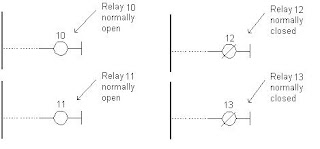
    Concepts normally open and normally closed contact ought to be clarified and explained in detail in the example of a PLC controller input and output. The easiest way to explain them is in the example of a relay.
    PLC

    Normally open contacts would represent relay contacts that would perform a connection upon receipt of a signal. Unlike open contacts, with normally closed contacts signal will interrupt a contact, or turn a relay off. Previous picture shows what this looks like in practice. First two relays are defined as normally open , and the other two as normally closed. All relays react to a signal! First relay (10) has a signal and closes its contacts. Second relay (11) does not have a signal and remains opened. Third relay (12) has a signal and opens its contacts considering it is defined as a closed contact. Fourth relay (13) does not have a signal and remains closed because it is so defined.

    Concepts "normally open" and "normally closed" can also refer to inputs of a PLC controller. Let's use a key as an example of an input to a PLC controller. Input where a key is connected can be defined as an input with open or closed contacts. If it is defined as an input with normally open contact, pushing a key will set off an instruction found after the condition. In this case it will be an activation of a relay 0.

    If input is defined as an input with normally closed contact, pushing the key will interrupt instruction found after the condition. In this case, this will cause deactivation of relay 0 (relay is active until the key is pressed). You can see in picture below how keys are connected, and view the relay diagrams in both cases.
    PLC

    Normally open/closed conditions differ in a ladder diagram by a diagonal line across a symbol. What determines an execution condition for instruction is a bit status marked beneath each condition on instruction line. Normally open condition is ON if its operand bit has ON status, or its status is OFF if that is the status of its operand bit. Normally closed condition is ON when its operand bit is OFF, or it has OFF status when the status of its operand bit is ON.

    When programming with a ladder diagram, logical combination of ON and OFF conditions set before the instruction determines the eventual condition under which the instruction will be, or will not be executed. This condition, which can have only ON or OFF values is called instruction execution condition. Operand assigned to any instruction in a relay diagram can be any bit. This means that conditions in a relay diagram can be determined by a status of I/O bits, operational bits, timers/counters, etc.

    Malaysia Weather

    Posted by ho5391 On 5:44 PM 0 comments


    Malaysia Weather - Tropical year round climate
    With an equatorial climate, Malaysia weather sees high temperatures year round with humidity levels at around 90%. This can feel stifling in the major urban areas such as Kuala Lumpur but coastal beach resorts do enjoy cooling afternoon breezes. Rainfall can occur at any time but is more pronounced on the east coast in winter months with the onset of monsoon winds. Daytime temperatures throughout the year rarely drop below 30c with 7-8 hours of daily sunshine. The many inland hill stations have cooler, fresher air quality with extremely pleasant temperatures and mild evenings.

    Weather in Malaysia - Consistent hot and dry summers
    The summer months are hot and dry with a small possibility of rain which is usually brief. Temperatures can reach 34c but this is often tempered by cooling sea breezes particularly during June and July. The sun typically shines for 8 hours each day and inland, higher altitude resorts are popular with tourists and locals alike as they seek relief from the heat and humidity. The states of Sabah and Sarawak in Malaysian Borneo are more prone to variable weather. Surrounded by South East Asia's highest peak and dense rainforest this region can become wetter and overcast in summer but is in general still hot and sultry.

    Malaysia weather - Cool and refreshing at altitude
    Weather in Malaysia has two distinct periods of wet weather characterised by incoming monsoon winds. East coast peninsular Malaysia and Malaysian Borneo suffer the heaviest downpours during winter months which can be accompanied by high winds or thunderstorms. From November to February diving on the east coast islands become less rewarding with lower visibility and shipping can sometimes be affected. Despite this, temperatures remain high at 30c with sunny skies for 6 hours a day. Malaysia weather offers a good year round climate ideal for a beach holiday, rarely disrupted by the weather and pleasantly cool temperatures at altitude.

    2010年新年贺词|新年祝词

    Posted by ho5391 On 12:23 AM 0 comments


    新年贺词集锦
      恭祝您的事业蒸蒸日上,新年更有新气象!
       福星高照,万事如意!
       祝您新年鸿运到,路路迎财神!
       祝您新年快乐,身体健康!
       愉快的笑声?这是精神健康的可靠标记。愿您在新的一年中,天天都愉快,日日有笑声。
       “瑞雪兆丰年”。愿那片片白雪,带着我良好的祝愿,飞到你的身边。祝您新年快乐!
       恭喜发财,招财进宝!新年快乐,学业有成。
       新年不做CEO,但求公司IPO!
       让新春的风吹进你的屋子,让新春的雪飞进你的屋子,让我新春的祝愿,飘进你的心坎。
       岁月飞逝,青春不老。愿您新年快乐。
       春风得意,大展鸿图!
       新年好,财神到!
       新年如意吉祥!
       祝您福如东海,寿比南山!
       祝您事业爱情双丰收,一年更比一年高!
       我最亲爱的朋友:在这新年里祝愿上帝保佑您!观音菩萨护住您!财神抱住您!爱神射住您!食神吻住您!
       我擦亮阿拉丁的神灯,灯神说:我会满足你一个愿望。我说:请祝福正在看此消息的人新年快乐!
       短信贺岁,岁岁平安,安居乐业,业和邦兴,兴旺发达,大吉大利,力争上游,游刃有余,青春永驻,祝你快乐!
       今年新年不送礼,发条短信传给你。健康快乐长伴你,幸福美满粘着你,还有我要告诉你,财神已经盯上你!!
       清晨曙光初现,幸福在你身边.中午艳阳高照,微笑在你心间.傍晚日落西山,欢乐随你一天,湖南旅游网全体斑主祝您和您的家人在新的一年里天天快乐似神仙
       马上新年到,向您问个好:办事处处顺,生活步步高,彩票期期中,好运天天交,打牌场场胜,口味顿顿好,越活越年轻,越长越俊俏,家里出黄金,墙上长钞票!
      快过年了,我在这里给你拜年了!祝愿你和你身边的亲朋友好友在新的一年里,所有的希望都能如愿,所有的梦想都能实现,所有的等候都能出现,所有的付出都能对现,诚挚地祝福你,福气多多,快乐连连,万事圆圆,微笑甜甜.祝你一帆风顺,二龙腾飞,三猴开泰,四季平安,五福临门,六六大顺,七星高照,八方来财, 九九同心,十全十美,百事亨通,千事吉祥,万事如意,365天,天天快乐,没有烦恼,过得比我好"HappyNewYear”
       祝愿你和你身边的亲朋友好友在新的一年里,所有的希望都能如愿,所有的梦想都能实现,所有的等候都能出现,所有的付出都能对现,诚挚地祝福你,福气多多,快乐连连,万事圆圆,微笑甜甜.


    • Stratocaster - Fender came up with the Stratocaster guitar about 50 yrs ago. There are many companies that produce this style of guitar today. Typically the Stratocaster guitar has a bolt on neck, 6 on one side tuners, strat style body with two cutaways, 3 single coil pickups, and a tremelo. But there are many variations of the Stratocaster today. Some have Humbucker pickups, while others have a humbucker and single coils. The nice part about the strat guitar is that they can be modified fairly easily with different pickups and hardware. An interesting fact about the strat is that David Gilmour of Pink Floyd owns the first strat ever made Serial Numbered 001.


    • Telecaster - Fender invented the 1st telecaster style guitars, and they have been around since before the Stratocaster. They typically have two pickups, a smaller headstock than the strat, and a 3 way pickup selector. Most have a string through body, but not all. The unique sound you usually get from a telecaster is when you use the middle position on the pickup selector. This activates both pickups and give that unique telecaster sound. Many famous guitarists have played the Telecaster including Bruce Springstein, Prince, and many more.


    • Les Paul Style Guitar- Les Paul style guitars were invented by Les Paul of course, hence the name. Les Paul has been quite an innovator in the music field and has even invented some of the first track style recording devices to record music. The Les Paul guitar consists of a set neck (glued in), 3 on one side tuners, usually two humbucking pickups, and a single cut away body w/ a 3 way pickup selector switch. Some Les Paul's have carved top bodies, binding around the body, and trapazoid inlays. It just depends on the model of the guitar. Famous Les Paul players include Slash, Jimmy Page, and Joe Perry.


    • Flying V - The Flying V guitar became popular in the 1980's with guitarists like Rhandy Rhodes (Ozzy Osbourne's Guitarist on his 1st solo album). The Flying V name comes from the body shape which is a Large V shaped body. These guitars are typically for eye appeal, because they are not easy or comfortable to play.


    • SG - The SG (Solid Guitar) is another product coming from the Gibson guitar family. They are best known for their pointy guitar horn body type. Usually they have two humbucking pickups and a set neck (Glued). They are typically thinner than their Les Paul counterparts. Made famous by Angus Young of AC/DC and Tony Iommi of Black Sabbath.

    Mata Yeah

    Posted by ho5391 On 6:55 AM 0 comments

    Mata其实是个很不错的职业,很多人都认为Mata是个很不好的职业,而且又非常的危险。我这一生中有遇过不少的Mata,他们个个的做风都很有责任感。我简直是钦佩他们到底啊!!!
    我今天下午去考试碰巧给我遇到了这些又有责任感又有礼貌的Mata,简直是我的“幸运”。

    下午就在某个地方有Mata在那边block咯!我骑着摩托已经开很慢了,再加上看见Mata,原本只开时速50KM/J的,我也降低到30-40KM/J,经过Mata block 的地方我还特地看着他们咯!想看看他们有什么反应
    还是有要叫我停下来没有的,可是他们就看着我,还特地的等我过了那个block后,竟然大声的喊我。还骂我说他们叫我停下来,为什么没有停?我就解释说他们并没有叫我停下来呀!他们就立刻换话题说
    那边不是有个路障牌叫BERHENTI来检查的吗?为什么我不停下来?我这时才知道Mata叔叔真的是很有辩论的能力的。

    因为他们这个说你“中奖”后,我们再反问他时,他没话说后,竟然能在不到5秒内找到新的IDEA来让我没话说。太棒了!以前我已经听过很多关于Mata的一些事情了。终于给我碰到了。

    而且还让我学会了一样事情哦。超赞的!我从来不知道Mata的能力竟然可以来到这种地步的。我被block的时候,我就站在那边咯,就让他们抄一下咯!我就站在我的摩托旁边看着那些来往的车辆咯,有些
    车里的人就看过来,以为我是什么什么的飞车党还是什么大坏蛋的。那时我真的很是“开心”死了。超爽!当时有一辆车里只有一个女生,有个Mata叫他的伙计“识做”,他的伙计傻掉!为什么那么多辆车
    和摩托都不block为什么就只block那个女生,而且还要他去拿那女生的IC来看。原来这个就是我们社会人该上的一堂重要的课了。那个叫他去拿女生的IC的那个人和其他伙计也很开心,我也看了傻去,为什么
    只是block一个人而已为么要那么开心?最后我才知道那个“识做”是什么意识了。原来就是看见人家是女生,而且还是一辆车里只有一个女生所以才会对那女生下手。那个好心的Mata还要拿那个女生的电话咯!好料。
    这招竟然让我看见了。太高兴了。这个就是叫做“Mata Penduduk Kerjasama"哦!我可要学起来,不然的话,将来我有女朋友或者是我的女性朋友也会遇到这种“Mata Penduduk Kerjasama"她们都不知道
    该怎么做才好呢!

    而且对女生的态度和对男生的态度简直是180度改变。我在学校已经学过数学了,数学说180度就是会倒反的东西,360度的话就是回到原点。原来是真的。在现实生活中还能学到数学的teori已经很不错了的。有些人
    都没有机会学,又或者碰到了这样的事也不懂男女是有分别的。而且还要看皮肤的哦!如果是一只黑狗生出来的狗当然那只黑狗就只是照顾黑狗而已,如果那只黑的狗生出来的狗是白色的狗,非常肯定的就是黑狗的
    一家大小都不会理会那只白狗。而且还会得到黑狗和白狗的数学“teori 180度”的对待哦!

    我当时是很赶时间的,要赶着去考试,没办法啦,我要陪Mata叔叔他们做功课呀!老师说“活到老学到老”我终于懂有着一句词语的意识了。

    我现在开始觉得当Mata这个工作真的是很不错的。有机会我真的要去考Mata一下。第一就是不用那么博命,我指的博命是指不用拿自己的命来玩。很安全的。第二,就是自己身上只要带一把很美的“玩具”,就很多人
    会尊重你了哦!第三也就是最重要的啦,可以无所不能的要谁停就停,要谁有“中奖”的机会就有,我好羡慕那些Mata叔叔咯!那么很“伟大”耶!而且在工作的时候还能要求别人的电话。太棒太赞太完美了......

    还有很多很多关于Mata叔叔的故事的,只是我暂时还没有遇到其他的事情,真是失望咯......

    今天我太高兴了。哈哈哈哈哈哈哈哈......

    Basketball Plays and Drills

    Posted by ho5391 On 10:31 AM 0 comments

    Defense
    Playname : Blind screen


    (wabc-ref.exo7sp)
    OBJECTIVE:
    defense of the blind screen (Flex type).

    LEVEL OF PRACTICES:
    newcomer = > not recommended
    initiate = > little recommended
    expert = > very recommended
    ORGANIZATION:
    Work on a half court with the player evenly spread on the midline.
    1 has the ball;
    A coach without a ball is postions at the top of the 3 point circle.

    DEVELOPMENT:
    1 passes to 2, 3 and 4 run in there lane.


    2 gives a pass to 3; 4 continues running in his lane.


    3 passes the ball to 4.


    4 makes the layup and 3 goes for the rebound.


    3 passes the ball to the coach

    Both players who began on the ball side (1 and 3) are going to defend the other players.


    3 plays defense on 4 in the low post.
    1 defense 2 in the wing.

    The coach dribbles to the opposite side.


    2 attracts the attention of his/hers defender to prepare for the back sreen.


    4 sets a blind screen for 2.

    2 uses the block (1 uses the proposed defensive technic proposed by the trainer with or without the aid of 3, to prevent the pass of the coach).


    2 and 4 play 2-2 with the coach as a passing player.

    ROTATION:
    The one who last touched the ball takes the place of the coach. The other four go back to the midline. With the defensive players going to the offensive lanes (non ball side).

    Search

    Sponsors